
Where To Install Smoke Detector In Bedroom With Ceiling Fan?

Every year in the United States, home fires claim thousands of lives. The NFPA says three out of five home fire deaths happen in homes without smoke alarms. They also occur in homes with non-functional alarms — and that number is sobering.
This brings up a critical question for homeowners and renters alike: Where To Install Smoke Detector In Bedroom With Ceiling Fan?
It sounds like a simple question. But ceiling fans create a unique challenge. The airflow they create can push smoke away from your detector. This means the alarm might go off too late — or not at all. In a bedroom, where you’re most vulnerable while sleeping, that delay can be deadly.
This guide is written by Archie M. Guerrero, a Home Decoration and Repair Specialist based in New York, NY. Archie has helped many homeowners. He sets up safe smoke detector systems. These systems follow local codes. This post is part of our comprehensive Complete Bedroom Guide — a full resource covering everything you need to create a safer, smarter, and more beautiful bedroom.
In this post, Archie shares important details. He explains how ceiling fans affect smoke detection. He covers the best placement rules. He shares installation tips, too. Also, he points out common mistakes to avoid. Whether you’re a homeowner or renter, this guide will help you get it right.
Key Takeaways:
- It’s important to know where to place a smoke detector in a bedroom with a ceiling fan. This helps with early fire detection.
- Don’t put a smoke detector right under a ceiling fan. Moving air can slow down smoke from reaching the sensor.
- The ideal spot is at least 3 feet away from the fan blades, on the ceiling or high on a wall.
- Dead air spaces in corners cause delays in smoke detection. Fan drafts also contribute to this problem.
- Check your smoke detector every month. Replace its batteries each year. This keeps your bedroom safe all year long.
Where To Install Smoke Detector In Bedroom With Ceiling Fan?

Smoke detectors save lives. A smoke detector in the wrong place, such as a bedroom with a ceiling fan, may not work when needed. It might miss smoke and leave you unprotected.
Ceiling fans are wonderful for comfort. They keep air moving and help regulate temperature. But that constant airflow creates a problem for smoke detection. When smoke rises toward the ceiling, a fan can scatter it in multiple directions. If your detector is right under the fan, smoke might not reach it. If it is too close to the blades, the same thing can happen.
The NFPA says to install smoke alarms away from air vents. Keep them distant from ceiling fans and other moving air sources. Place your detector where smoke flows naturally. Avoid spots where air currents can push it away.
In the U.S., NFPA 72 sets the standard for smoke detector installation. Following these rules is smart. It might also be required by your local building code.
Why Ceiling Fans Make Smoke Detector Placement Truly Tricky
If you’ve ever stood under a ceiling fan and watched how air moves, you’ll understand the challenge. Ceiling fans push air downward in summer mode and pull it upward in winter mode. They create air currents across the ceiling. This is where smoke travels to trigger a detector.
Here’s what happens in a typical bedroom fire scenario:
- Smoke begins to rise from the source (a candle, electrical outlet, mattress, etc.)
- It moves upward toward the ceiling
- The ceiling fan disrupts the smoke’s path
- Smoke gets pushed sideways, toward the walls, or scattered unevenly
- A poorly placed detector misses the smoke entirely — or detects it much later
The NFPA reports that working smoke alarms can cut the risk of dying in a home fire in half. But that statistic assumes the alarm is placed correctly. A detector in the wrong spot is almost as dangerous as no detector at all.
In New York City apartment buildings, Archie M. Guerrero has seen this issue firsthand. Many tenants put smoke detectors on the ceiling. They often forget about where the fan is. The result? Detectors that alarm too late — or trigger false alarms from kitchen steam pushed by the fan.
Key facts to know:
- Ceiling fans can move air at speeds between 50–100 CFM (cubic feet per minute)
- That airflow is enough to delay smoke detection by 30 seconds or more
- In a fast-moving fire, 30 seconds can be the difference between escape and tragedy
Reposition your detector today and test it right away. It could save a life.
Next, let’s look at the exact rules for where to place your detector.
The Simple Rules: Where To Install Smoke Detector In Bedroom With Ceiling Fan the Right Way

The good news is that the rules aren’t complicated. Once you understand them, placement becomes straightforward. The NFPA gives clear guidelines. The U.S. Consumer Product Safety Commission (CPSC) does too.
Here are the core rules:
- Never place a detector directly below a ceiling fan — the downdraft will push smoke away
- Keep the detector at least 3 feet away from fan blades on all sides
- Mount on the ceiling when you can. Smoke rises, so ceiling placement captures it quickly.
- If wall-mounting, place the detector 4 to 12 inches below the ceiling — not lower
- Stay away from corners — corners trap air and create “dead air spaces” where smoke is slow to travel
These rules work for any fan. Whether you have a box fan, a decorative bedroom fan, or a big industrial ceiling fan, they all apply. The brand doesn’t matter — airflow is airflow.
In states like California and Florida, building codes often go a step further. They require interconnected smoke alarms throughout the home, including in every bedroom. If one alarm triggers, they all sound. This is the safest setup for any home.
Practical checklist for placement:
- Identify the center of the ceiling in your bedroom
- Locate the ceiling fan — note the direction of its blades
- Measure 3 feet outward from the fan blades in all directions
- Choose a spot within that safe zone, ideally close to the center of the room
- Confirm the spot is not near an air vent, window, or door draft
This quick five-step check takes under five minutes. It can make your bedroom much safer.
Now let’s get more specific about distance.
Best Distance: How Far Should a Smoke Detector Be From a Ceiling Fan?
Distance is everything when it comes to ceiling fan and smoke detector placement. Too close, and the fan disrupts detection. Too far, and the detector may be in a dead air zone near the wall.
The NFPA 72 code recommends a minimum distance of 3 feet between a smoke detector and any ceiling fan blade tip. This is not a suggestion — it’s a code requirement in most U.S. jurisdictions.
Here’s how to think about it practically:
- Measure from the outermost tip of the fan blade
- Draw an imaginary circle with a 3-foot radius around the fan
- Your detector must be outside this circle
Most bedroom ceiling fans have blade spans between 42 and 52 inches. That means the blades extend roughly 21 to 26 inches from the center. Add 3 feet (36 inches) to that, and your detector should be at least 57 to 62 inches from the fan’s center point.
In a standard 12×12 bedroom, which is common in American homes, you find a cozy area. This spot is near the center of the ceiling and away from the fan. In larger bedrooms (14×16 or bigger), you can place the detector closer to the sleeping area.
Distance quick reference:
| Fan Blade Span | Fan Radius | Min. Safe Detector Distance From Center |
| 42 inches | 21 inches | ~57 inches (~4.75 feet) |
| 52 inches | 26 inches | ~62 inches (~5.2 feet) |
| 60 inches | 30 inches | ~66 inches (~5.5 feet) |
Archie suggests using a measuring tape. Mark the spot with painter’s tape before you drill. It takes an extra five minutes but ensures a code-compliant, effective installation.
Up next — the specific zones in a bedroom where placement works best.
Proven Spots: Ideal Placement Zones in a Bedroom
Now that you know the rules and distances, let’s talk about where to put the detector. We’ll focus on real bedroom layouts.
Every bedroom is a little different. Some have fans centered on the ceiling. Others have fans offset near the foot of the bed. Some rooms are small and square. Others are long and rectangular. Here’s how to find the best zone for each layout.
For a square bedroom (10×10 to 12×12):
- The fan is usually centered on the ceiling
- Place the detector about 4–5 feet from the fan, offset toward one wall
- Avoid corners — stay at least 12 inches from any wall
For a rectangular bedroom (12×14 or larger):
- The fan may be centered or shifted toward one half of the room
- Place the detector in the half of the room without the fan, roughly centered
- This gives the detector a clean line of sight for rising smoke
For L-shaped or irregularly shaped bedrooms:
- Install two detectors if needed — one in each “zone” of the room
- Always keep both detectors 3 feet away from the fan and 12 inches from walls
General placement tips:
- Aim for the center of the room when possible
- Avoid placing detectors above air vents, near windows, or next to doors
- If your bedroom has a vaulted or sloped ceiling, put the detector within 3 feet of the peak. Just keep it 3 feet away from the fan.
Archie says that older New York brownstones have unique ceiling shapes. The same goes for walk-up apartments. This is especially true in the bedrooms. He always suggests placing the detector on the ceiling above the sleeping area. This spot is the most important to protect.
Give your bedroom a fresh look at its smoke detector placement this week — your safety depends on it!
Next, let’s compare ceiling mounting vs. wall mounting in a bedroom with a fan.
Wall vs. Ceiling Mounting — Which Is Better With a Fan?
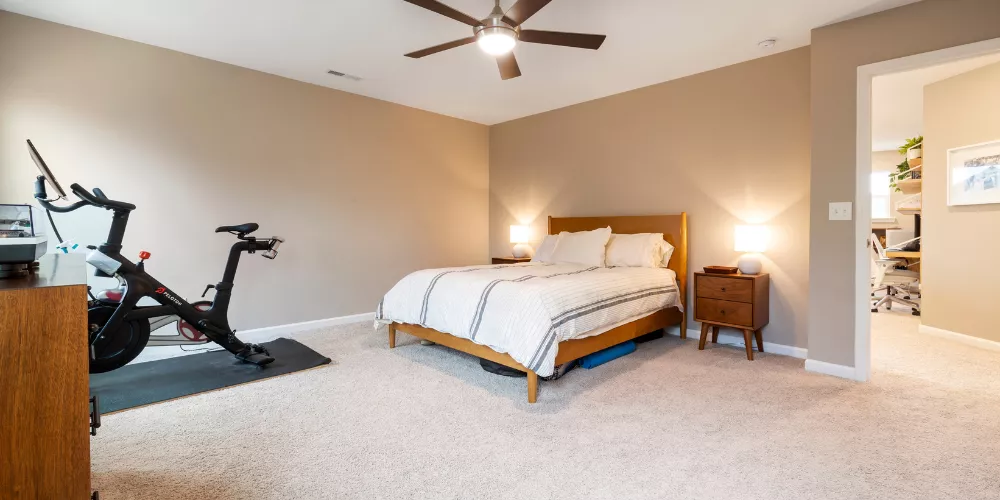
Most homeowners assume ceiling mounting is always best. And in most cases, it is. Smoke rises naturally to the ceiling, so a ceiling-mounted detector catches it fastest. When a ceiling fan is there, wall mounting is a smart choice—if done right.
Ceiling mounting pros:
- Smoke rises directly to the detector
- Fastest detection time in most scenarios
- Recommended by NFPA as the primary method
Ceiling mounting cons:
- A ceiling fan can scatter smoke before it reaches the detector
- In small rooms, finding a compliant spot can be challenging
Wall mounting pros:
- Positions the detector below the fan’s air disruption zone
- Useful when ceiling space is limited or fan placement makes ceiling mounting difficult
- Can be easier to access for testing and battery replacement
Wall mounting cons:
- Must be mounted 4 to 12 inches below the ceiling — no lower
- Smoke that stays near the ceiling may take longer to reach a wall-mounted detector
- Not ideal in rooms with very high ceilings (above 9 feet)
The CPSC recommends ceiling mounting as the first choice. If you can’t mount the fan on the ceiling, choose a wall mount. Just make sure to stick to the 4-to-12-inch rule.
In cities like New York, Chicago, and Los Angeles, many apartments are high-rise. They often have concrete ceilings. Because of this, wall mounting is more common. Drilling options are limited. A wall-mounted detector can work as well as a ceiling-mounted one. It just needs to be placed correctly.
Quick rule of thumb: If you can achieve the 3-foot fan clearance on the ceiling, mount there. If not, use the wall — correctly.
Now let’s tackle one of the most overlooked dangers: dead air spaces.
Dead Air Spaces — The Hidden Danger You Must Avoid
Dead air spaces are a common issue in smoke detector installation. Many people overlook them. These spaces can prevent smoke from reaching the detector. As a result, the alarm may not go off when needed. It’s important to check for these areas to ensure proper function. They’re areas in a room where air doesn’t flow well. This means smoke can build up and take longer to reach the detector.
The most common dead air spaces in bedrooms are:
- Corners where two walls meet
- The junction between a wall and ceiling (especially within 4 inches of either surface)
- Areas behind large furniture like headboards or wardrobes
- Spots directly under ceiling fans where downdraft creates stagnant zones
The NFPA specifically warns against placing smoke detectors in dead air spaces. Detectors must be at least 4 inches away from any wall if mounted on the ceiling. If mounted on the wall, they should be at least 4 inches from the ceiling.
Here’s why this matters: in a corner, two walls trap air. Smoke entering that corner moves slowly. A detector in that spot might not go off until smoke fills most of the room. By then, escaping could be hard.
How to identify dead air spaces in your bedroom:
- Light a stick of incense and observe how smoke moves in the room
- Notice where smoke drifts slowly or seems to “pool”
- Avoid placing your detector in those zones
- Look for areas where air moves freely — that’s where smoke will travel first
Archie has done this test in dozens of New York bedrooms. He says the results are always eye-opening. “Most people are shocked to see how much a ceiling fan changes where smoke actually goes,” he notes.
Avoiding dead air spaces can boost your detector’s response time. That extra time can save lives.
Let’s now look at how smart smoke detectors handle bedroom fan challenges.
Smart Smoke Detectors and Ceiling Fan Bedrooms
Technology has made smoke detectors smarter and more reliable than ever. Smart detectors in bedrooms with ceiling fans have benefits. Traditional detectors do not have these.
What makes a smoke detector “smart”?
- Wi-Fi or Z-Wave connectivity
- App-based alerts sent to your phone
- Self-testing features
- Integration with smart home systems like Amazon Alexa, Google Home, or Apple Home Kit
- Some models use multiple sensor types (photoelectric + ionization) for faster detection
Top smart detector options for bedroom use:
- Nest Protect by Google is a popular smart detector in the U.S. It uses split-spectrum sensing. It also provides a gentle warning before the full alarm sounds.
- First Alert Onelink works with Apple HomeKit. It also has a built-in speaker for weather alerts.
- Ring Alarm Smoke & CO Listener — pairs with Ring’s security ecosystem
For rooms with ceiling fans, Archie recommends the Nest Protect. It’s a great choice. Its split-spectrum sensor finds fast-burning and slow-smoldering fires. It works well, even when a fan disrupts smoke.
Placement still matters for smart detectors. No amount of technology can overcome a fundamentally bad installation location. A smart detector under a ceiling fan won’t work as well as a basic detector in the right spot.
Smart detector tips for ceiling fan bedrooms:
- Use the detector’s app to monitor sensitivity settings
- Set monthly test reminders through the app
- Enable interconnection with other alarms in the home
- Use the self-test feature every 30 days
Smart detectors typically cost between $50 and $130 — a small price for the safety they provide. Many U.S. homeowners insurance policies give discounts. They reward homes with monitored smoke alarms.
Upgrade to a smart detector this season — and place it right for maximum protection!
Next, let’s cover the most common mistakes people make.
Common Mistakes Homeowners Make With Bedroom Smoke Detectors
Even well-intentioned homeowners make placement and maintenance mistakes. Here are the most common ones Archie sees — and how to fix them.
Mistake 1: Placing the detector directly under the ceiling fan This is the number one error. The fan’s airflow disrupts smoke travel. Always maintain the 3-foot minimum clearance.
Mistake 2: Mounting in a corner Corners are dead air zones. Smoke accumulates there slowly. Move your detector at least 12 inches from any corner.
Mistake 3: Installing too low on the wall If wall-mounting, the detector must be 4 to 12 inches below the ceiling. Lower than that, and smoke may not reach it in time.
Mistake 4: Ignoring Battery Replacement The NFPA suggests replacing batteries every year. You can also use a 10-year sealed battery detector. Dead batteries are responsible for 25% of smoke alarm failures in U.S. homes.
Mistake 5: Not testing the detector Test your smoke detector every month. Just press the test button.Many homeowners set a reminder on their phone for the first of each month.
Mistake 6: Using the wrong detector type. There are two main types: ionization and photoelectric. Ionization alarms detect fast-flaming fires better. Photoelectric alarms detect slow-smoldering fires better. For bedrooms, the NFPA suggests using two separate units or a combo detector.
Mistake 7: Forgetting to replace old detectors Smoke detectors have a lifespan of 8 to 10 years. Check the manufacture date on the back of your detector. If it’s older than 10 years, replace it immediately.
Avoiding these seven mistakes sets you apart from most American homeowners. It boosts your bedroom fire safety.
Finally, let’s talk about how to test whether your placement is actually working.
How To Test Your Smoke Detector Placement Is Working
Installing a smoke detector in the right spot is step one. Confirming it actually works is step two — and it’s just as important.
Here’s how to test your detector placement properly:
Basic button test:
- Press and hold the test button on the detector
- The alarm should sound within a few seconds
- If it doesn’t sound, replace the battery and test again
Real smoke test:
- Light a match or a stick of incense near — not directly under — the detector
- With the ceiling fan running at its normal speed, hold the smoke source about 6 inches below the detector
- The alarm should trigger within 30 to 60 seconds
- If it takes longer, or doesn’t trigger, consider repositioning the detector
Fan speed test:
- Run this test with the fan on low, medium, and high settings
- The detector should trigger at all three speeds
- If it fails on high speed, the fan may be creating too much airflow at your current placement
NFPA recommended testing schedule:
- Test monthly (button test)
- Test with real smoke annually
- Replace batteries every 12 months (or when the low-battery chirp starts)
- Replace the entire unit every 8–10 years
Many fire departments in the U.S. offer free home fire safety inspections. This includes the New York City Fire Department (FDNY). These inspections include checking smoke detector placement. It’s worth calling your local fire department to ask about this service.
A quick monthly test takes less than 30 seconds. Make it a habit — and make your bedroom safer tonight.
Quick Summary
Installing a smoke detector in a bedroom with a ceiling fan is crucial for safety. Ceiling fans can mess with airflow. This might delay or stop smoke from reaching a detector if it’s in the wrong place. Place the detector at least 3 feet from fan blades. Mount it on the ceiling or high on the wall. This way, it will work properly when you need it most.
Key Points Covered:
- Ceiling fans create airflow that can scatter smoke and delay detection
- Always maintain a 3-foot minimum clearance from fan blade tips
- Ceiling mounting is best. Wall mounting is also good if it’s 4–12 inches below the ceiling.
- Avoid dead air spaces — corners, ceiling-wall junctions, and spots directly under the fan
- Smart detectors like Nest Protect offer advanced sensing ideal for fan-equipped bedrooms
- Test your detector monthly and replace it every 8–10 years
- Follow NFPA 72 guidelines for code-compliant, life-saving installation
Frequently Asked Questions
Many people wonder where to install a smoke detector in a bedroom with a ceiling fan. Many American homeowners find this topic confusing. This is especially true when a ceiling fan changes the rules. Here are the main questions Archie hears from clients. Below are clear, simple answers.
Where to install smoke detector in bedroom with ceiling fan for best results?
The best spot is on the ceiling, at least 3 feet away from the outermost tip of the ceiling fan blades. Aim for a position that’s also at least 4 inches from any wall. This keeps the detector away from the fan’s airflow. It still catches rising smoke effectively. If you can’t mount the fan on the ceiling, mount it on the wall. Place it 4 to 12 inches below the ceiling. Always follow NFPA 72 guidelines for your specific room size and layout.
Can I put a smoke detector on the wall instead of the ceiling in a bedroom with a fan?
Yes, wall mounting is a good choice. This is especially true if a ceiling fan makes it tough to place a ceiling-mounted detector. The critical rule is to mount the detector between 4 and 12 inches below the ceiling line. Any lower and rising smoke may not reach it. Wall mounting also makes it easier to test and maintain the unit. The CPSC considers wall mounting acceptable as long as placement follows official guidelines.
How far should a smoke detector be from a ceiling fan?
According to NFPA 72, a smoke detector should be at least 3 feet from the outermost tip of ceiling fan blades. This minimum clearance stops the fan’s airflow. It keeps the smoke from blocking the path to the sensor. For fans with blade spans of 52 inches or more, place the detector 5 to 6 feet from the fan’s center. Always measure from the blade tip, not the motor housing.
What type of smoke detector is best for a bedroom?
For bedrooms, the NFPA says to use a dual-sensor smoke detector. It needs both ionization and photoelectric sensing. Ionization sensors detect fast-flaming fires quickly. Photoelectric sensors detect slow fires. These fires smolder. They often occur in bedrooms. Mattresses and upholstery can catch fire. Combination units, like the Kidde KN-COSM-IBA and Nest Protect, combine two technologies. They offer everything you need in one device.
Where to install smoke detector in bedroom with ceiling fan if the room is very small?
In a small bedroom (under 100 square feet), space is tight. If the ceiling fan is centered, the 3-foot clearance rule may push your detector close to a wall. In that case, wall-mount the detector on the wall closest to the foot of the bed, at 4 to 12 inches below the ceiling. This keeps it away from the fan’s airflow. Still, it stays close to the sleeping area to quickly detect smoke. Test placement carefully in small rooms using the real smoke test method.
Conclusion
Fire safety in the bedroom is not something to leave to chance. When you have a ceiling fan in your bedroom, it’s important to know where to install the smoke detector. This knowledge is crucial for safety.
Let’s recap the key takeaways from this guide:
First, always keep your smoke detector at least 3 feet away from the tip of your ceiling fan blades. This rule is non-negotiable. It’s backed by NFPA 72, the gold standard for fire alarm installation in the U.S.
Second, ceiling mounting is your best option in most cases. If you can’t install the detector on the ceiling due to fan placement, mount it on the wall. It should be between 4 and 12 inches below the ceiling. Both methods work well when placed correctly.
Third, avoid dead air spaces — especially corners and spots directly under the fan. These areas slow down smoke detection. This can mean the difference between a quick alarm and a dangerous delay.
A family in suburban Ohio decided to move their bedroom smoke detector. They made this change after reading a guide like this one. They shifted their detector from the ceiling fan. Three months later, it spotted a slow-burning electrical fire in the wall. They were able to evacuate safely. That’s the real-world power of correct placement.
Home safety is a continuous commitment — not a one-time task. Test your detector every month. Replace the battery every year. And replace the full unit every 8 to 10 years.
If you liked this guide, share it with a friend or family member who has a ceiling fan in their bedroom. You could literally be saving a life. Save this page for later. Also, explore our full bedroom safety and design guide for expert tips.
For more expert home decoration and repair tips, visit our Complete Bedroom Guide — your go-to resource for a safer, smarter, more beautiful bedroom.